Agile Tools for Stable Organizations

…. Achieve impact with ease!

Faster, higher, further, more. In the world of work, the need for tools that enable new agility is growing along with the challenges faced by leaders and employees alike. It is important to be able to make decisions and act quickly in constantly changing, highly complex environments. At the same time, stakeholders need to be involved and customer requirements taken into account.

Newly founded, small start-up companies are using this idea to implement state-of-the-art organizational formats and report wonderful successes and extraordinarily productive work cultures. But how should this be understood from the perspective of a traditionally structured organization that is not necessarily striving for a comprehensive transformation? What can established companies with a traditionally hierarchichy-oriented mindset learn from these tools? Do these two worlds even fit together?

We have taken a look around some organizations and are convinced that this can work – with caution. But first things first.
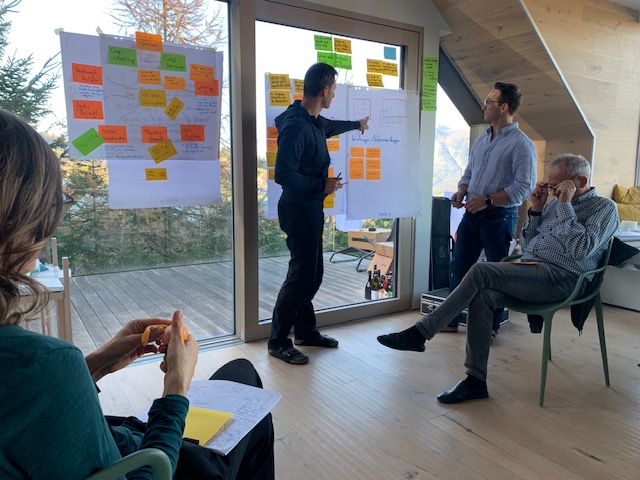
Working Agile in a New Work environment

Many talk about it, many claim to be: agile. What is meant by it varies widely—it can refer to customer orientation, responsiveness, self-organization, or participation, among other things.

In a nutshell, “agility” arose from the following intention:
… to enable faster decision-making and action in complex environments.
… to react more adaptably and dynamically to change.
… to work close to the customer in a needs-oriented manner.

This requires developing an attitude often referred to as an agile mindset—one that supports the practices mentioned above. To enable this, organizations build new approaches (mindset), structures (networks), ways of working (cross-functional), and methods (e.g., sprints, Kanban, team reviews). Traditional, planned, and hierarchical action is replaced by a step-by-step approach (= iterations) that delivers small, usable outcomes (increments).
Hierarchies are becoming less important, while self-organization is becoming central. Communication and a willingness to develop and change are essential.

“New Work” uses agile working methods to describe a working environment that does justice to the structural changes in the world of work. The goal is to create space for creative, digital, remote and collaborative work. In doing so, organizations aim to attract and retain employees (especially well-educated experts from younger generations) while boosting productivity and innovative capacity.

Agile for Classic” – the quadrador of the circle?

New work and agility are certainly providing exciting approaches and methods for becoming more customer-oriented and adaptable. In principle, these approaches also promise a lot of advantages for existing and hierarchically grown organizations. However, the kind of radical cultural change required by the principle of agility in its full expansion stage is not readily conceivable in many organizations. Or such an approach is simply not supported by the owners or responsible managers. The threshold for committing to this direction is too high, as most concepts of agile frameworks present themselves as “all-in” – in other words: either change all structures and, above all, the mind-set, or do not be agile at all.

So what could be more obvious than using the best of both worlds? To turn an either/or into a both/and! We have studied several organizations and publications and can report with confidence: Agile methods are also suitable for “classic” organizations. It is important to consider in what form and to what extent or at what point they appear suitable. The following topics are a good place to start:

  • Meeting structures and processes for appropriate addressing and participative processing of operational and structural topics
  • Sprint logic, Kanban or elements from design thinking for development projects
  • Decision-making processes and tools for optimal decision-making
  • Define responsibilities and roles for clarity in collaboration
  • Tension-based communication for responsiveness

It is important to pay close attention to cross-functional processes and collaborations to ensure that both logics and their differences receive adequate consideration.

We are happy to join you on this journey of exploration or to support your organization in the practical application of agile approaches.

Fatal error: Uncaught Error: Class "OMGF" not found in /home/.sites/33/site2421/web/relaunch-2020/wp-content/plugins/host-google-fonts-pro/includes/frontend/class-optimize.php:1019 Stack trace: #0 /home/.sites/33/site2421/web/relaunch-2020/wp-content/plugins/host-google-fonts-pro/includes/frontend/class-optimize.php(311): OmgfPro_Frontend_Optimize->process_fallback_font_stacks() #1 /home/.sites/33/site2421/web/relaunch-2020/wp-content/plugins/host-google-fonts-pro/includes/frontend/class-optimize.php(135): OmgfPro_Frontend_Optimize->process_inline_styles() #2 /home/.sites/33/site2421/web/relaunch-2020/wp-includes/class-wp-hook.php(341): OmgfPro_Frontend_Optimize->process() #3 /home/.sites/33/site2421/web/relaunch-2020/wp-includes/plugin.php(205): WP_Hook->apply_filters() #4 /home/.sites/33/site2421/web/relaunch-2020/wp-content/plugins/host-webfonts-local/src/Frontend/Process.php(441): apply_filters() #5 /home/.sites/33/site2421/web/relaunch-2020/wp-includes/class-wp-hook.php(341): OMGF\Frontend\Process->process() #6 /home/.sites/33/site2421/web/relaunch-2020/wp-includes/plugin.php(205): WP_Hook->apply_filters() #7 /home/.sites/33/site2421/web/relaunch-2020/wp-content/plugins/host-webfonts-local/src/Frontend/Process.php(745): apply_filters() #8 [internal function]: OMGF\Frontend\Process->return_buffer() #9 /home/.sites/33/site2421/web/relaunch-2020/wp-includes/functions.php(5493): ob_end_flush() #10 /home/.sites/33/site2421/web/relaunch-2020/wp-includes/class-wp-hook.php(341): wp_ob_end_flush_all() #11 /home/.sites/33/site2421/web/relaunch-2020/wp-includes/class-wp-hook.php(365): WP_Hook->apply_filters() #12 /home/.sites/33/site2421/web/relaunch-2020/wp-includes/plugin.php(522): WP_Hook->do_action() #13 /home/.sites/33/site2421/web/relaunch-2020/wp-includes/load.php(1308): do_action() #14 [internal function]: shutdown_action_hook() #15 {main} thrown in /home/.sites/33/site2421/web/relaunch-2020/wp-content/plugins/host-google-fonts-pro/includes/frontend/class-optimize.php on line 1019